Explore 34 articles about time mastery & habits.
Learn how freelancers track billable hours and focus quality. Compare 5 tracking methods, optimize your schedule, set smarter rates, and bill every minute you earn.
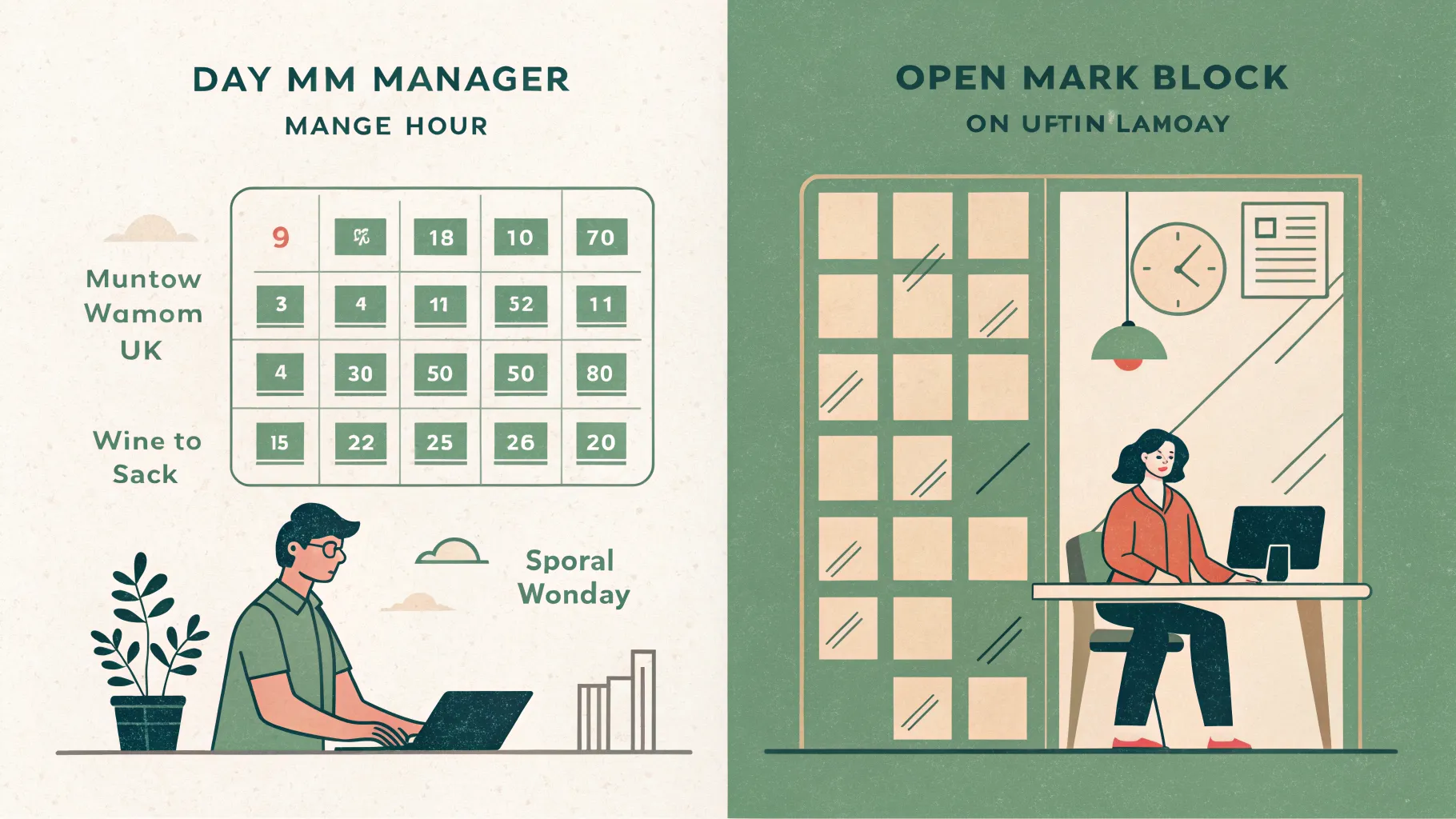
Solopreneur productivity depends on protecting maker hours from manager tasks. Learn 9 strategies, backed by research, to measure and increase your real output.
A second brain captures ideas, tasks, and knowledge outside your head so your working memory stays free for deep work. Learn how to build one that actually improves focus and output.
** Work efficiency means doing things right. But effectiveness means doing the right things. Learn the Drucker distinction, how to measure your personal work efficiency, and the highest-leverage chang
** Discover a practical time management system built for freelancers: multi-client focus, ADHD-friendly strategies, and behavioral tracking that connects your hours to your income.
** Time tracking and productivity tracking measure different things. One records hours; the other measures output quality. Learn the difference and when you need each.
** A productivity score measures your actual output quality relative to your focused effort. Learn what makes a meaningful score, how to calculate it, and how AI makes it more accurate.
** Discover the productivity metrics that actually work for knowledge workers: by role. Covers developers, writers, analysts, and freelancers with behavioral tracking methods.
** Learn how to track your focus time accurately: from manual logs to automatic AI tracking. Includes metrics, methods, and ADHD-specific approaches for knowledge workers.
** Productivity tracking is not the same as time tracking. Learn what to actually track, why behavioral data beats manual timers, and which tools do it right.
** Learn how to measure productivity as a knowledge worker using output-based, behavioral, and AI-driven methods. Includes metrics, frameworks, and tools.
** Digital minimalism is a philosophy of intentional technology use coined by Cal Newport. Learn the 3 core principles, the 30-day declutter, and how to start today.
** Cognitive load is the mental effort your working memory uses to process information. Learn the 3 types, what causes overload, and 7 strategies to manage it at work.
** Analysis paralysis is the state of overthinking a decision until you can't act at all. Learn the causes, the science, and 7 evidence-backed strategies to break free.
** The PARA method organizes all your information into Projects, Areas, Resources, and Archives. Learn how it works, how to set it up in any app, and why it beats other systems.
** Temptation bundling pairs a guilty pleasure with a task you keep skipping. Learn the Milkman research, step-by-step setup, and examples for real work.
** Decision fatigue is the decline in decision quality after making too many choices. Learn the science, spot the signs, and use 8 proven strategies to protect your focus.
Attention residue is the cognitive state where an incomplete task continues competing for your attention after you've nominally switched to something else. It explains why task-switching costs far more than the interruption itself.
Paul Graham's 2009 essay identified two incompatible ways of structuring time. Fifteen years later, the collision between them explains most of the productivity problems in modern knowledge work.
Body doubling means working in the presence of another person to improve focus and task completion. For ADHD brains, the effect is dramatic and backed by decades of social facilitation research.
Task batching groups similar tasks together and completes them in a single focused block. It works because every task switch costs far more than most people think.
The Eisenhower Matrix sorts every task into four quadrants by urgency and importance. The real insight is not what to do first. It is how much time you are spending on tasks that feel urgent but build nothing.
Parkinson's Law states that work expands to fill the time available for its completion. The corollary is equally useful: compress the time and the work compresses with it.
There are actually two different 2-minute rules. David Allen's version is for clearing small tasks now. James Clear's version is for making new habits impossible to avoid starting.
Inbox zero doesn't mean an empty inbox. It means zero mental energy spent on email. Here's what Merlin Mann actually intended, why people fail at it, and how to make it work.
A weekly review is a 30-minute practice of closing open loops, assessing your week, and planning the next. Here's the science, a simple template, and how to actually make it stick.
The Ivy Lee method is a daily planning system from 1918: write your 6 most important tasks the night before, work through them in order, repeat. Here's the neuroscience behind why it works.
A time audit reveals the gap between where you think your time goes and where it actually goes. Here's the science, a 4-category framework, and a step-by-step process.
The MIT method means identifying 1-3 most important tasks each day and doing them before anything else. Here's the psychology, the criteria, and how to make it work.
Timeboxing means assigning a fixed time limit to every task before you start. It's the simplest way to beat Parkinson's Law and stay in control of your day.
The eat the frog method means doing your most important, hardest task first thing every morning. Here's the science behind why it works and exactly how to use it.
Time blocking is a scheduling method where you assign specific tasks to specific time slots. Here is exactly how it works, why it beats a to-do list, and how to build your first time-blocked day.
The Pomodoro Technique is a time management method that breaks work into 25-minute focused sessions separated by short breaks. Here is exactly how it works and why the science backs it.
A standard full-time job has 2,080 work hours per year, based on 40 hours each week for 52 weeks.