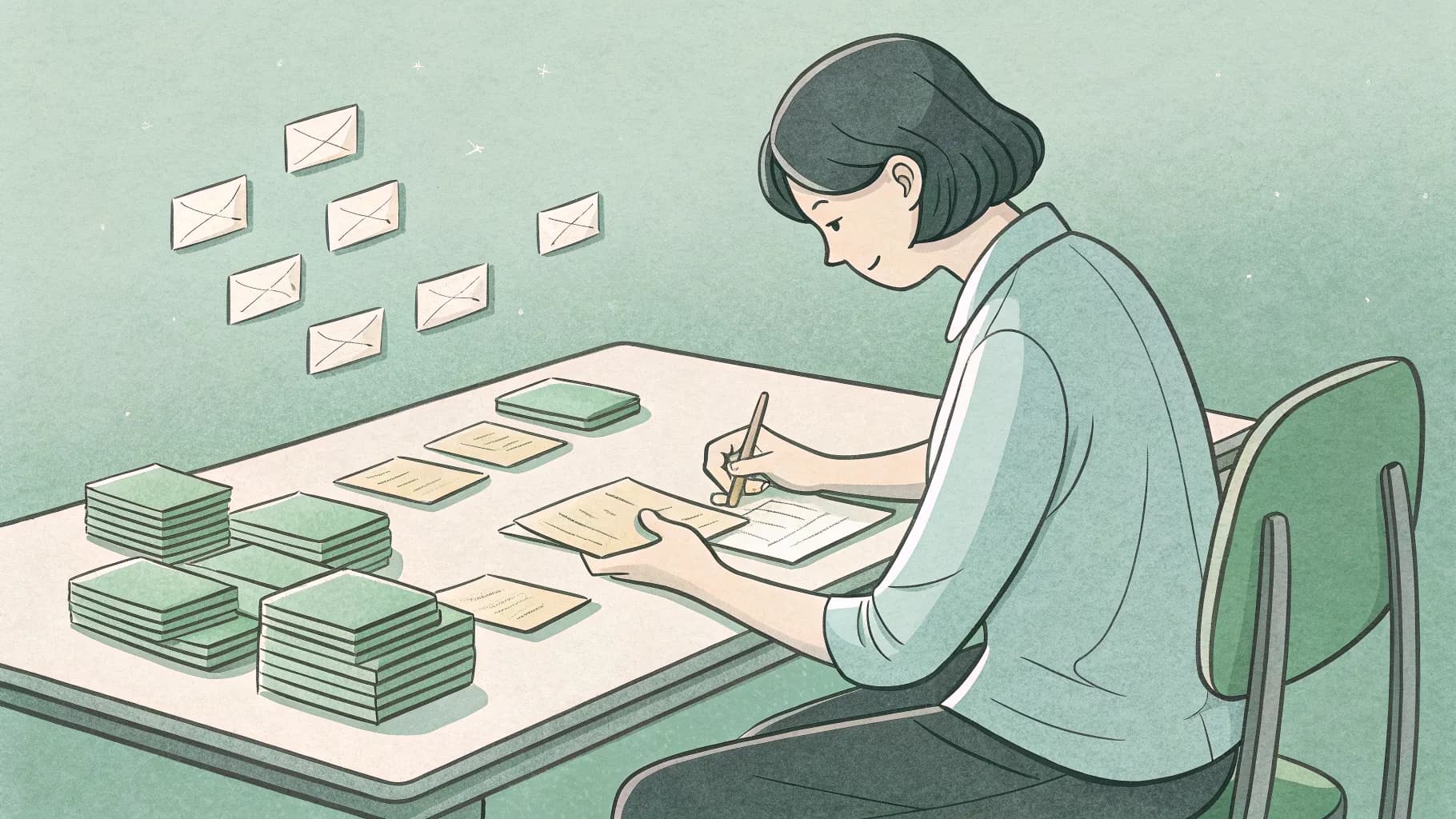
Every time you switch from one type of task to another, your brain pays a cost. It has to retrieve the mental context for the new task, load the relevant information, recall the goal, and re-establish focus. This takes time. It takes attention. And it happens every time you alternate between tasks, dozens or hundreds of times per day.
Dr. Gloria Mark at the University of California, Irvine spent years studying how knowledge workers actually use their time. Her finding: after an interruption, it takes an average of 23 minutes to return to the original task at full concentration. Not 23 seconds. Twenty-three minutes.
Task batching is the direct countermeasure. It eliminates most context switches by grouping similar tasks together and completing them in a single focused block. Instead of checking email three times between other tasks, you process email in one 30-minute window. Instead of doing code reviews as each pull request arrives, you batch them into a single afternoon slot. The number of task types you engage with per hour drops dramatically. The number of full-focus intervals per day rises proportionally.
Make10000Hours tracks how often you switch between different types of work throughout your day, showing you concretely where context-switching cost is fragmenting your output. Most knowledge workers are surprised by what the data reveals.
What Is Task Batching?
Task batching is a productivity strategy that involves grouping similar tasks together and completing them within one dedicated time block, rather than handling each task as it arrives throughout the day.
The core principle is task similarity. When consecutive tasks require similar cognitive modes, mental context, tools, or emotional states, switching between them has minimal cost. Writing one email and then another email uses the same mental context. Reviewing one pull request and then another uses the same technical context. Creating one social media graphic and then another uses the same creative context. Batch these, and you eliminate the overhead of context-switching between them.
Task batching is not the same as multitasking. Multitasking means attempting to perform multiple different tasks simultaneously, which research consistently shows impairs performance on all of them. Task batching means doing one type of task, completing it, and then doing the next type of task in its own block. It is the opposite of multitasking: radically focused switching between types of work, rather than constant parallel fragmentation.
The Context-Switching Science
The 23-minute refocus cost documented by Dr. Mark is not the only dimension of context-switching damage.
Research published by the American Psychological Association (2001) by Joshua Rubinstein, David Meyer, and Jeffrey Evans identified two separate cognitive processes that occur during task switching: "goal shifting" (deciding to switch) and "rule activation" (suppressing the old task's rules and retrieving the new task's rules). Both processes consume time and cognitive resources. Even brief, voluntary task switches produce measurable performance decrements.
A third dimension: residual activation. When you switch away from a task before completing it, the cognitive representation of that task remains partially active in working memory. This is what Dr. Sophie Leroy at the University of Washington calls "attention residue." The incomplete task continues drawing on cognitive resources even after you've nominally moved on. Batching reduces attention residue by allowing each task type to reach completion before the context shifts.
The combined effect: an unmanaged day of reactive task-switching can reduce effective working capacity by 20 to 40% compared to the same hours spent in focused, batched blocks. The hours are present. The cognitive capacity is not.
Three Types of Task Batching
Not all batching is the same. There are three distinct frameworks, each useful in different situations.
Type 1: Task-Type Batching (the most common)
Group tasks by cognitive type: all email at once, all meetings back-to-back, all writing in one block, all administrative work in another. The goal is to minimize context-type switching. This is the most straightforward form and works for any knowledge worker.
Type 2: Energy Batching
Match task type to the time of day based on energy level. High-cognitive, high-stakes work (writing, coding, strategy, design) gets your peak energy window, typically the first 2 to 3 hours after waking. Low-cognitive tasks (email, admin, scheduling) get your post-lunch or end-of-day lower-energy windows. This combines task batching with the biology of circadian energy rhythms.
Type 3: Project-Context Batching
Group tasks by project rather than by type, so that all work requiring the same project context happens in a single block. A freelancer on three active client projects would batch all work for Client A in one period rather than alternating between clients throughout the day. This minimizes the "mental model loading" cost of switching between entirely different projects.
For most knowledge workers, combining Type 1 and Type 2 produces the largest immediate gains. Type 3 is especially valuable for freelancers and developers working across multiple long-running projects.
How to Build a Task-Batched Day
Step 1: Audit your task types. For one day, write down every task you do and classify it by type: writing, coding, email/communication, meetings, review/feedback, administrative, creative production, planning. This reveals your actual task-type mix.
Step 2: Group your types into 3-5 batches. Most knowledge worker days reduce to: deep work (writing, coding, complex analysis), communication (email, Slack, messages), meetings, and admin. Four batch types.
Step 3: Assign batches to time windows. Deep work gets your highest-energy window (morning for most people). Communication gets a midday window. Meetings get another window. Admin gets end of day. Block these on your calendar using time blocking.
Step 4: Close everything except the current batch. During your email batch, your code editor should be closed. During your coding batch, your email client should be closed. Visible open tabs and notifications extend residual attention to those task types even when you're trying to batch.
Step 5: Use a capture list for batch violations. When something non-batch-relevant arrives during a focused block, write it on a capture list rather than acting on it. Address captures during the appropriate batch window.
Task Batching by Role
Software developers: The most natural batches are deep work (building features, debugging), code reviews (all PRs in one daily or twice-daily slot), communication (standup, Slack, async questions), and documentation (batched at end of sprint or week). The context-switching cost of reviewing a PR while deep in feature development is especially high because both tasks require holding complex technical context in working memory. They conflict directly. Keep them separate.
Freelancers: Client communication across multiple clients is the biggest batching opportunity. A freelancer who checks in with clients as each message arrives is switching project context dozens of times a day. Batch all client communication into two daily windows (morning before deep work, and end-of-day review). Reserve the middle of the day for the actual work that pays.
Creative professionals: The revision-vs-creation distinction is critical. Creating new work (writing, design, editing) requires a generative cognitive mode. Reviewing and revising existing work requires a critical, evaluative mode. These modes conflict: moving from creation directly into revision collapses the creative frame before the idea is fully developed. Batch creation in a separate block from revision, ideally with a day between them rather than just hours.

Task Batching vs Related Methods
| Method | Core mechanism | Best for | How they pair |
|---|---|---|---|
| Task batching | Group similar tasks into single blocks | Reducing context-switching cost throughout the day | The strategy that defines WHAT goes in each block |
| Time blocking | Assign specific time slots to tasks in advance | Protecting work from reactive scheduling | The scheduling tool that implements batching on the calendar |
| Single tasking | Focus on exactly one task at a time | Within-session focus quality | Works within each batch block |
| Deep work | Extended focus sessions on cognitively demanding work | High-complexity creative and intellectual output | Deep work is the maximum-intensity version of a task batch |
| Pomodoro technique | 25-minute focus intervals with short breaks | Maintaining energy and focus within a session | Can be used inside each batch block |
Task Batching for ADHD and Knowledge Workers
For people with ADHD, task batching offers two distinct advantages that address core ADHD impairments.
The first is reduced task initiation cost. Task initiation is the executive function most impaired by ADHD. Every time a new task must begin from zero, the ADHD brain faces the full activation energy cost of starting. Task batching reduces the number of full initiations per day. Within a batch, tasks flow from one to the next within the same cognitive context. The email batch that begins with one message continues through six more without the full initiation cost of switching into email mode after doing something else entirely.
The second is reduced decision overhead. ADHD brains are disproportionately burdened by open-ended decisions like "what should I work on now?" Batching creates a structure where the decision is already made. During the morning coding batch, the answer to "what now?" is always "the next coding task." The schedule contains the decision. This frees cognitive resources for the actual work.
Specific adaptations:
Start batches with the easiest item. For ADHD, the hardest part of a batch is the very first task. Beginning with the lowest-friction item in the batch builds momentum. By the second or third item, the cognitive mode is active and continuation is easier.
Keep batches short and time-bounded. An open-ended "email session" is harder for ADHD than "email for exactly 25 minutes." Use the Pomodoro technique inside each batch to create time pressure that activates the ADHD urgency-motivation system.
Use separate physical spaces for different batches when possible. Spatial context is a powerful attention anchor for ADHD. Deep work at a dedicated desk, communication from a different chair or room. Physical context change reinforces the task-type change.
Make10000Hours identifies your current context-switching patterns and shows when your highest-value work hours are being fragmented by reactive task switches. For knowledge workers trying to build a batched schedule, this baseline data reveals exactly where to start.
Frequently Asked Questions
Build the batches, block the time, and watch the 23-minute interruption tax start paying for itself.
Related articles