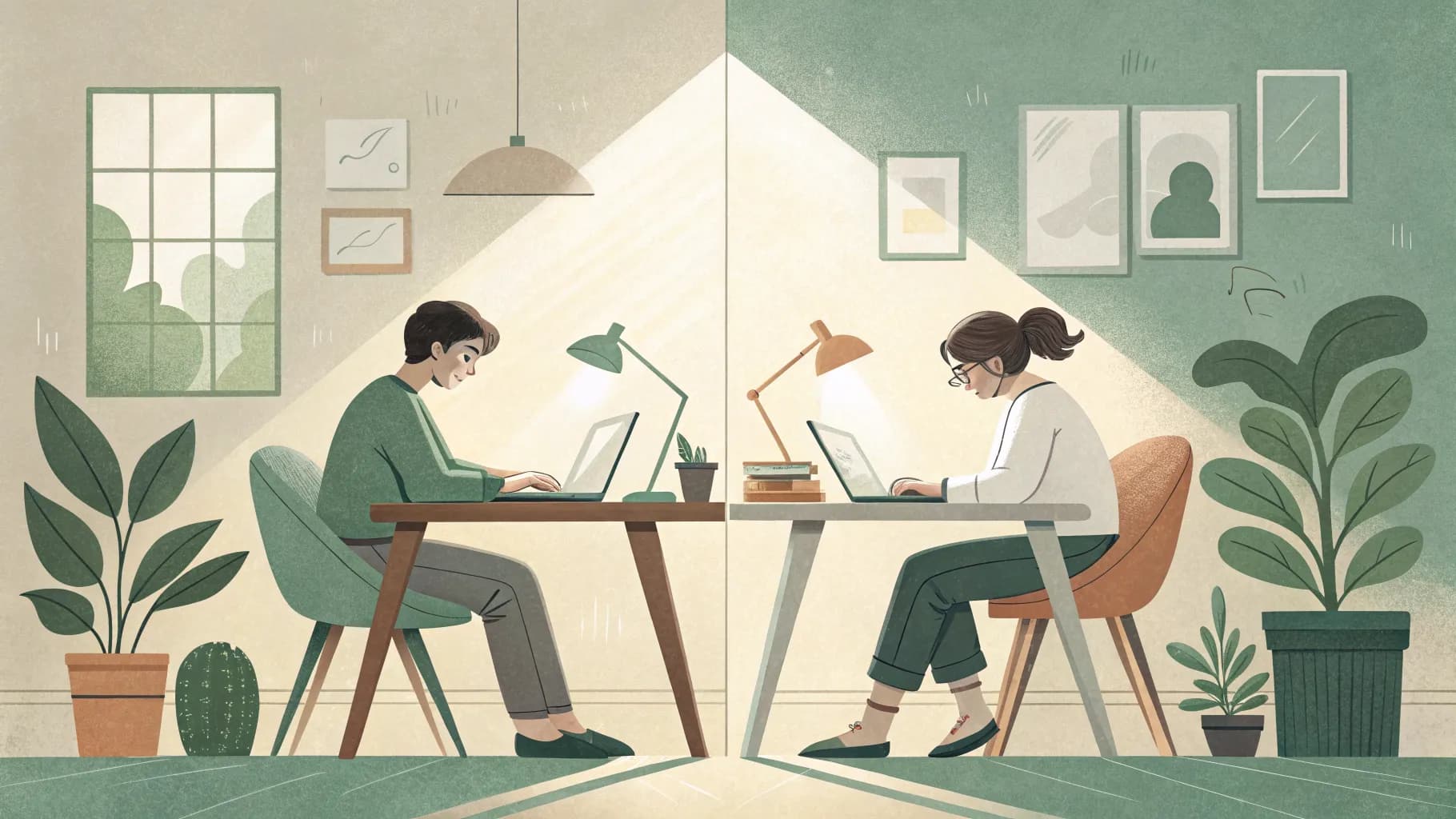
You sit down to do the task. You know what you need to do. You have the time. Nothing is stopping you except your own brain, which refuses to start.
Then someone else sits down nearby. A friend, a coworker, a stranger at a coffee shop. They are not helping you. They are not watching you. They are simply present. And you start. The task that had been impossible for three days gets done in forty minutes.
If you have ADHD, this experience is likely familiar. It is not a fluke, and it is not a sign that you can only work under surveillance. It is a documented psychological phenomenon called body doubling, and it has roots in research that predates the word ADHD by decades.
Make10000Hours tracks your actual focus patterns and shows you which working conditions produce your most concentrated output. For many ADHD users, the data confirms what they already suspected: co-presence changes everything.
What Is Body Doubling?
Body doubling is the practice of working in the presence of another person, where that person's primary function is not to collaborate or supervise, but simply to be there. The "double" is a human presence that anchors your attention and activates the motivational systems that ADHD impairs.
The term entered the ADHD community through ADHD coaches and advocates in the 1990s, used to describe a strategy that many people with ADHD had discovered independently: they could focus at a coffee shop in ways they could not focus at home alone. They could write a paper in a library where they were surrounded by people doing silent work. They could finally clean their apartment when a friend sat in the living room doing nothing in particular.
The double does not need to be working on the same task. They do not need to offer advice, accountability check-ins, or feedback. Passive presence is sufficient. The mechanism is not social pressure or fear of judgment, though those can contribute. The mechanism runs deeper.
The Science: Social Facilitation and Executive Activation
In 1965, social psychologist Robert Zajonc published a landmark paper resolving a long-standing puzzle in experimental psychology. Since the late 1800s, researchers had observed conflicting findings: sometimes the presence of an audience improved performance, sometimes it impaired it. Zajonc's insight: the presence of others increases physiological arousal, and arousal strengthens the dominant response for a given task. For well-practiced or simple tasks, the dominant response is the correct one, so performance improves. For novel or complex tasks not yet mastered, the dominant response may be incorrect, so performance declines.
This is social facilitation theory. And for ADHD, it directly explains why body doubling works on tasks that the person actually knows how to do but struggles to initiate or sustain.
ADHD does not primarily impair knowledge or skill. It impairs the executive functions that activate and sustain goal-directed behavior in the absence of external stimulation. The ADHD brain underproduces dopamine and norepinephrine in the prefrontal cortex under low-stimulation conditions, which causes tasks to feel harder to start, harder to stay with, and harder to return to after interruptions. This is not a willpower problem. It is a neurobiological regulation problem.
The presence of another person provides external stimulation. It raises arousal. It activates the social monitoring systems of the brain, which are wired to remain alert in the presence of others. For a person with ADHD attempting to complete a task they know how to do, this additional arousal is often exactly what tips the balance from stalled to executing.
Research published in the Journal of Attention Disorders and in studies on ADHD and environmental structure supports a consistent finding: ADHD adults perform substantially better on attention-demanding tasks in structured, co-present environments than in isolated ones, even when the structure is minimal.
Why It Works: The ADHD Brain's Unique Response
To understand why body doubling is particularly effective for ADHD, it helps to understand what ADHD actually impairs.
ADHD is primarily a disorder of self-regulation and executive function. The core impairments include: difficulty initiating tasks in the absence of urgency or interest, difficulty sustaining attention when external stimulation is low, hypersensitivity to reward and punishment signals, and impaired time awareness (time blindness). These impairments are neurobiological rather than motivational, driven primarily by dysregulation of dopamine systems in the prefrontal cortex and striatum.
The critical insight, articulated by ADHD researcher Dr. Russell Barkley, is that ADHD brains can often perform normally when sufficient external structure is provided. The impairment is in self-generated regulation, not in regulation per se. External cues, accountability structures, deadlines, and co-presence can supply the regulatory scaffolding that the ADHD brain fails to supply internally.
Body doubling is one of the most accessible and powerful forms of external structure. It requires no tools, no apps, no formal system. It works immediately. And unlike deadline pressure or punishment-based accountability, it does not rely on fear or stress as the motivating mechanism.
In-Person vs Virtual Body Doubling
One of the most practically significant developments in this field has been the discovery that virtual body doubling, working over a video call with another person in view, produces similar effects to in-person co-presence.
This matters enormously in a world where knowledge workers increasingly work from home. The isolation of home offices removes the ambient social presence of offices, libraries, and coffee shops that many ADHD knowledge workers had been unconsciously relying on for focus regulation.
Focusmate is the platform built specifically for virtual body doubling. Users book 50-minute sessions with a matched partner, exchange brief task intentions at the start, work silently on camera, and check in briefly at the end. The session structure is minimal: no conversation during work, no collaboration, no judgment. Pure co-presence with a light accountability layer. Thousands of users with ADHD report that Focusmate sessions are among the most reliably productive periods of their week.
Other virtual body doubling formats that work:
Discord co-working servers: Permanent voice or video channels where members work silently in co-presence. No obligation to speak. Join, mute your microphone, be present. Several large productivity Discord communities maintain active study-with-me channels around the clock.
Scheduled Zoom co-working: A recurring weekly session with a friend, colleague, or accountability partner. Both join video, state their goal for the session, work silently for a defined period, then briefly check in. This provides the relational commitment that makes the session reliably happen.
YouTube and Twitch live study sessions: Streamers who broadcast long silent work sessions with ambient music have accumulated audiences of hundreds of thousands. For some ADHD individuals, watching a real person working in real time provides enough social presence to anchor focus, even without mutual visibility.
Coffee shops and libraries: For those who can work outside the home, the traditional solution still works. The optimal coffee shop has ambient sound, occasional movement in the periphery, and low conversational density. Libraries provide visual co-presence without sound distraction.

How to Set Up a Body Doubling Practice
Body doubling works best as a scheduled, recurring practice rather than something you reach for only when stuck.
Step 1: Identify your highest-resistance tasks. These are the tasks you have been avoiding, the ones that sit on your to-do list for days without progress. Body doubling is most valuable for exactly these tasks, not for easy or automatic work.
Step 2: Choose your format. In-person or virtual. Focusmate for a low-friction structured option. A scheduled friend call for a relational approach. A coffee shop for ambient co-presence. Discord for asynchronous community. Pick the format that has the lowest barrier to actually starting.
Step 3: Define the session. Before the session begins, write down exactly what you intend to work on. One specific task, not a category. "Write the introduction section of the quarterly report" rather than "work on report." Specificity activates intention and reduces the decision load at session start.
Step 4: Remove non-session inputs. Phone face-down. Notification-generating applications closed. The body doubling session works because it provides external activation, not because it competes with every other source of stimulation. Give it a clear channel.
Step 5: Pair with the Pomodoro technique. The Pomodoro method works especially well inside body doubling sessions. The 25-minute timer creates urgency that adds to the arousal provided by co-presence. Two complementary external activation sources are more reliable than one. For ADHD, the ticking timer becomes a social performance structure: the other person is present, the timer is running, both of which activate the systems that self-regulation alone fails to sustain.
Body Doubling vs Other ADHD Productivity Strategies
| Strategy | Mechanism | Effort to set up | Works for task initiation | Works for sustained focus |
|---|---|---|---|---|
| Body doubling | Social facilitation, external arousal | Low | Yes, strongly | Yes |
| Pomodoro technique | Time pressure, urgency intervals | Very low | Moderately | Yes |
| Task batching | Reduced initiation count, context preservation | Low | Moderately | Yes |
| Eisenhower matrix | Clarity on what to work on | Low | No (prioritization only) | No |
| Medication | Dopamine/norepinephrine regulation | Requires prescription | Yes | Yes |
| Exercise | Prefrontal dopamine activation | Moderate | Indirectly (30-60 min later) | No |
Body doubling is the only non-pharmacological strategy that directly addresses task initiation through external arousal rather than internal regulation. This is why it often works when other strategies fail: the other strategies require self-regulation to implement. Body doubling bypasses the need for self-regulation entirely.
Body Doubling for Non-ADHD Knowledge Workers
Although body doubling was developed and named within the ADHD community, its effectiveness extends beyond ADHD.
Zajonc's social facilitation research was conducted on neurotypical subjects. Co-working spaces became one of the defining business trends of the 2010s precisely because knowledge workers without ADHD also produced better work in shared environments than in isolated home offices. The mechanisms are less pronounced than for ADHD, but they operate in the same direction.
Software developers and engineers specifically benefit from structured co-working sessions because deep technical work requires the kind of sustained activation that social presence provides, without the interruption that collaboration would create. Pair programming, in its traditional software engineering sense, is a formalized version of body doubling where both parties work on the same problem. But even solo deep work on different problems benefits from the ambient co-presence structure.
Freelancers who work from home report body doubling as one of the most effective counter-measures to the isolation that erodes motivation and focus. A weekly body doubling session with another freelancer, even one in a completely different field, provides the co-presence structure that office environments supply automatically.
Make10000Hours measures your actual focus quality across your working sessions. If you are a remote knowledge worker finding that your home sessions consistently show fragmented focus compared to co-working or coffee shop sessions, body doubling may be the missing structural variable.
Frequently Asked Questions
The hardest part of many ADHD days is not the work itself. It is beginning. Body doubling solves the beginning problem, which is why it is often the first strategy ADHD coaches recommend.
Related articles