Student time management is the practice of deliberately allocating your limited hours toward the academic work that produces results, while protecting the sleep and recovery that make those hours effective. A 2021 meta-analysis of 158 studies found that time management behaviors explain 26.2% of the variance in student academic performance, a bigger predictor than most students realize, and bigger than SAT scores according to a foundational 1991 study by Britton and Tesser.
If you want to learn how to learn faster, the system starts before you open a textbook. It starts with how you manage your time.
Make10000Hours is a session tracker built for students who want to measure not just study hours but quality focused reps toward mastery. It shows you exactly how many deliberate study hours you've accumulated per subject, which is the data that predicts exam performance better than any generic study tip.
Table of Contents
- Why Most Students Waste 60% of Their Study Time
- The Four Time Management Traps College Students Fall Into
- The Student Time Management System That Actually Works
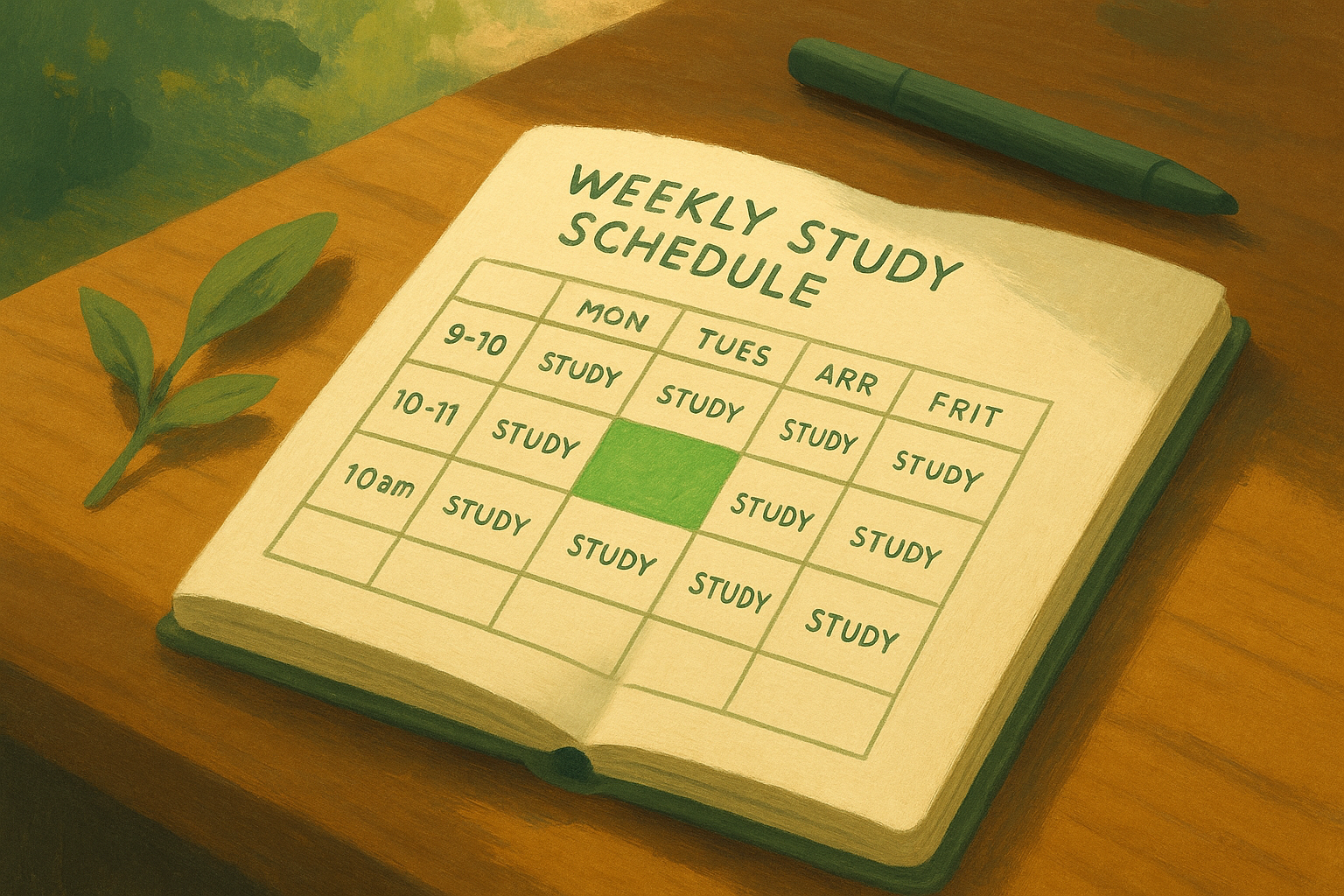
- How to Build a Study Schedule You'll Actually Follow
- Applying Deliberate Practice to Academic Mastery
- How to Track Whether Your System Is Working
- Frequently Asked Questions
Why Most Students Waste 60% of Their Study Time
Most students don't have a time shortage. They have a focus quality problem.
The typical college student sits down to study and spends a meaningful portion of that session switching between tabs, scrolling between tasks, rereading the same paragraph, and generally going through the motions of studying without engaging deeply. The hours are logged. The learning is not.
Research on deliberate practice from Ericsson, Krampe, and Tesch-Romer (1993) established the core distinction: accumulated hours and focused, intentional repetition with feedback are not the same thing. Deliberate practice produces exponentially greater skill gains than passive review. The same principle applies to studying. Passive re-reading generates a feeling of familiarity, not actual retention or comprehension.
The 2025 BMC Psychology study by Fu, Wang, and colleagues surveyed 1,016 undergraduates and found that time management influences study engagement through two key pathways: self-control (accounting for 27.56% of the total effect) and reduced phone dependence (18.54%). More than half of time management's benefit on actual engagement operates through behavioral mechanisms, not through having a better planner.
That is the real problem. Students who say they have trouble managing their time are often actually struggling with attention regulation and task initiation. The techniques covered in this guide address both.
A 2024 survey by the American College Health Association found that 47.5% of US college students reported their academic performance being negatively affected by procrastination. A separate Kahoot! study in 2023 found 47% of college students cite time management as their biggest academic challenge. The scale is not personal failure. It is a structural gap between how high school prepares students and what college actually demands.
High school provides external structure: bells, assigned seats, daily homework checks, parent reminders. College removes almost all of that. For the first time, you are responsible for managing 45 to 60 hours of academic work per week across your own schedule. Most students are never taught how to do that.
The Four Time Management Traps College Students Fall Into
Understanding where time disappears is the first step to reclaiming it.
1. The Cramming Trap. Students default to marathon study sessions right before exams because the urgency feels motivating and the hours feel productive. The problem is that cramming produces short-term familiarity, not durable learning. The Ebbinghaus forgetting curve shows that without review, 50% of new material is forgotten within 30 minutes and 70 to 80% is gone within 24 hours. Cramming is rebuilding the same shaky structure over and over, right before it gets tested.
2. The Procrastination Trap. Psychologist Piers Steel's 2007 meta-analysis of 691 correlations found that 80 to 95% of college students procrastinate, with 50% being chronic procrastinators. Procrastination is not laziness. It is an avoidance response triggered by task aversiveness, low self-efficacy, or fear of evaluation. It correlated with lower GPA (r = -.16), lower assignment performance (r = -.21), and lower exam scores (r = -.17) across the studies Steel reviewed. One study estimated that last-minute submission costs students an average of 5 percentage points on their grade.
3. The Over-Scheduling Trap. Many students create detailed color-coded schedules on Sunday nights and abandon them by Tuesday. Over-scheduled plans create fragility. Every unexpected event (a longer class discussion, a social obligation, a migraine) breaks the plan, which triggers guilt, which triggers more avoidance. A good time management system builds in flexibility and treats disruptions as expected rather than exceptional.
4. The Passive Review Trap. Rereading notes, highlighting textbooks, and watching lecture recordings feel productive. They generate low-effort familiarity without the cognitive load that actually builds memory. The students who spend the most hours "studying" often score lower than students who spend fewer hours on high-effort retrieval practice. This gap is why active recall and spaced repetition outperform re-reading in virtually every study that compares them.
The Student Time Management System That Actually Works
There is no system that works perfectly for everyone. There is, however, a framework supported by evidence that works for most students when applied consistently. It has four components.
1. Time blocking with implementation intentions. Research by Gollwitzer (1999) on implementation intentions found that specifying when, where, and how you will do a task increases follow-through rates by 2 to 3 times compared to vague intention-setting. "I will study" is not a plan. "I will study organic chemistry flashcards in the library study room from 2pm to 3:30pm on Tuesday and Thursday" is a plan. The specificity is what activates the commitment.
Block your study sessions in your calendar like classes. Treat them as appointments, not suggestions.
2. The Pomodoro Technique for session structure. The Pomodoro Technique breaks study sessions into 25-minute focused intervals followed by 5-minute breaks. The mechanism is not arbitrary: sustained focus in tight intervals aligns with the brain's attention restoration curve and prevents the cognitive fatigue that accumulates during long unstructured sessions. After four Pomodoros, take a longer break of 15 to 30 minutes.
The key is strict rule-following: when a Pomodoro starts, nothing else exists. One task, one timer, no interruptions. If a distraction arises, write it down and return to it after the interval.
3. Priority ranking using the urgent and important matrix. Not all tasks deserve the same calendar real estate. The Eisenhower matrix divides tasks into four categories: urgent and important (do now), important but not urgent (schedule), urgent but not important (delegate or batch), and neither urgent nor important (eliminate). For students, most high-value academic work falls into the "important but not urgent" category. Exams three weeks away are important. They rarely feel urgent. The system is to schedule them before they become urgent.
4. SMART goals at the session level. Vague goals correlate with procrastination (Steel 2007). Before each study session, write one specific, measurable goal: "Complete practice problems 1 through 15 in Chapter 4" rather than "study chemistry." The specificity makes starting easier (you know exactly what to do) and creates a clear completion signal (you know when you are done).
How to Build a Study Schedule You'll Actually Follow
The foundation of student time management is a realistic weekly schedule built on the credit hour standard.
The US Department of Education credit hour standard, used by most universities and sometimes called the Carnegie Unit, establishes that students should expect 2 to 3 hours of out-of-class study per credit hour per week. A standard 15-credit semester requires 30 to 45 hours of study per week, on top of 15 hours of class time. That is a 45 to 60 hour academic work week.
Most students do not know this number. They estimate they need "a few hours" and are perpetually behind.
Step 1: Start with fixed blocks. Map every non-negotiable: class times, work shifts, meals, sleep (7 to 9 hours), and any recurring commitments. These are immovable. They define the actual hours you have left.
Step 2: Apply the 2 to 3 hour rule. For each class, multiply its credit hours by 2.5 to estimate weekly study hours needed. A 3-credit chemistry course requires roughly 7.5 hours of study per week. Block those hours explicitly in your calendar, not in your head.
Step 3: Use a dual calendar. Cornell's Learning Strategies Center recommends maintaining two calendar views: a semester overview showing all major deadlines, exams, and projects, and a weekly view with specific daily study blocks. The semester view prevents surprises. The weekly view keeps you executing.
Step 4: Distribute sessions, do not stack them. Three 90-minute sessions across a week are more effective than one 4.5-hour block for the same material. The spacing effect from spaced repetition research confirms that distributed practice outperforms massed practice for long-term retention. If you block "chemistry" for 4 hours on Sunday, you are cramming. If you block it for 90 minutes on Tuesday, Thursday, and Saturday, you are learning.
Step 5: Schedule leisure and recovery deliberately. Plans that leave no room for social life, exercise, or rest are plans that get abandoned. Block 2 to 3 hours of genuine leisure time per day. Protect it. A schedule with recovery built in is far more durable than an aspirational schedule that burns students out within a week.
Applying Deliberate Practice to Academic Mastery
The core insight from Ericsson's deliberate practice research is that what separates top performers from average ones is not how many hours they put in. It is the quality and intentionality of those hours.
Deliberate practice in academic contexts means:
- Studying at the edge of your current understanding, not within your comfort zone
- Using retrieval practice (testing yourself) rather than recognition practice (re-reading)
- Getting immediate feedback on errors, through answer keys, office hours, study groups, or self-explanation
- Maintaining focused attention for the full session duration, not letting the mind wander while the eyes scan text
The students who consistently outperform their study-hour count are the ones using active recall, working through practice problems under test conditions, explaining concepts aloud, and reviewing errors carefully. They are not studying harder. They are studying more deliberately.
This is why tracking study hours alone misses the point. A student who logs 40 hours of passive re-reading per week is likely getting a fraction of the academic return of a student logging 20 hours of deliberate, focused retrieval practice.
Track every study session in Make10000Hours: the subject, the duration, and the focus quality. After a semester you'll see exactly how many hours you've put into each subject toward mastery. Most students are shocked to discover they've spent 40 hours "studying" but only 8 of those were truly focused sessions. That gap is the opportunity.
How to Track Whether Your System Is Working
A time management system without measurement is just a to-do list you feel guilty about.
The signal most students use is emotion: "I feel like I studied a lot this week." That signal is unreliable. The sessions that feel most productive (long, comfortable, familiar) are often the least effective. The sessions that feel hardest (retrieval practice, working through difficult problems, confronting gaps) are the most effective.
What to actually measure:
Focused session hours per subject. Not total time spent, but the hours where you were actively engaged with no significant distraction. Track this weekly by subject. A student should be able to say: "I put in 7 focused hours on statistics this week, 5 on writing, and 4 on biology." That granularity is what makes it possible to diagnose where a grade is going wrong before an exam.
Session completion rate. Of the sessions you blocked in your calendar, what percentage did you actually complete? A completion rate below 70% indicates either over-scheduling (the blocks are too optimistic) or procrastination that needs a process change.
Subject distribution over time. One of the clearest predictors of poor exam performance is discovering in week 12 that you have put very few hours into a difficult subject all semester. Tracking hours by subject over time catches that imbalance early.
Sleep hours. Sleep is not separate from time management. The npj Science of Learning (2019) found that sleep quality, duration, and consistency accounted for nearly 25% of the variance in academic performance. Sleep deprivation reduces memory consolidation by 20.39% and concentration by 22.72%. Students who protect 7 to 9 hours of sleep and schedule study sessions around their highest-energy hours are treating time management as the full system it is, not just a scheduling problem.
The BMC Psychology 2025 study by Fu and colleagues confirmed that time management reduces mobile phone dependence, which increases study engagement. Tracking your sessions creates awareness of the gap between "time spent near a textbook" and "focused time engaged with learning material." That awareness, consistently applied over a semester, compounds.
Frequently Asked Questions
Why do students struggle with time management?
Students struggle with time management primarily because college removes the external structure that made it feel automatic in high school. No more daily homework checks, scheduled study halls, or parental reminders. Suddenly you are managing 45 to 60 hours of academic work per week across an unstructured calendar. Research by Steel (2007) also shows that 80 to 95% of college students procrastinate regularly, which is not a character flaw but an avoidance response triggered by task difficulty, low confidence, or fear of failure. The practical fix is to rebuild external structure deliberately: block study sessions in your calendar like classes, set specific goals before each session, and track what actually gets done.
What is the best time management strategy for a college student?
The most evidence-backed approach combines three elements: time blocking with implementation intentions (scheduling specific tasks at specific times, which doubles follow-through rates according to Gollwitzer 1999), the Pomodoro Technique for session structure (25-minute focused intervals with breaks), and spaced study distribution across the week rather than marathon cramming sessions. No single technique works in isolation. The combination of planning when to study, how to study during each session, and spacing sessions across the week addresses the three main failure points in student time management.
How many hours should a college student study per day?
The standard expectation is 2 to 3 hours of out-of-class study per credit hour per week, from the US Department of Education credit hour standard used by most universities. For a 15-credit semester, that means 30 to 45 hours of study per week, roughly 4 to 6 hours per day on weekdays. Most students are significantly below this target. The more important variable is not total hours but focused hours: 3 hours of deliberate, distraction-free retrieval practice outperforms 6 hours of passive re-reading for actual learning and exam performance.
How do I make a study schedule I'll actually stick to?
Build your schedule in this order: (1) block all fixed commitments including sleep, class, meals, and work; (2) calculate your required study hours using the 2 to 3 hours per credit hour rule; (3) distribute those hours across multiple shorter sessions rather than a few long blocks; (4) schedule leisure and recovery explicitly so the plan is sustainable; (5) add buffer time on Fridays or Sundays for anything that slipped. The most common reason schedules fail is over-optimism: every hour is filled, there is no room for anything to go wrong, and the first disruption breaks the whole system. Build in slack deliberately.
What causes procrastination in college students?
Procrastination is primarily an avoidance response to tasks that feel aversive, uncertain, or threatening to self-image. Steel's 2007 meta-analysis identified three main drivers: task aversiveness (the work feels boring or frustrating), low self-efficacy (not believing you can do it), and impulsiveness (difficulty overriding short-term comfort). Importantly, procrastination is not about time. A student who procrastinates does not need better time management skills first. They need to reduce the aversiveness of the task itself: break it into a specific first step, reduce the stakes of beginning, and create an environment where starting is easier than avoiding.
How does sleep affect academic performance?
Sleep has a direct, quantified effect on academic performance. A 2019 study in npj Science of Learning found that sleep quality, duration, and consistency accounted for nearly 25% of the variance in academic performance across college students. Separate research found that sleep deprivation reduces memory consolidation by 20.39% and concentration by 22.72%. Despite this, a 2023 Kahoot! survey found that 31% of college students get 5 hours of sleep or less per night. Scheduling 7 to 9 hours of sleep is one of the highest-return time management decisions a student can make, because it determines how well the study hours they do log actually convert to retained knowledge.
How do I know if I'm studying effectively?
The clearest signal is not how long a session feels but whether you can retrieve the information afterward without looking. Test yourself immediately after studying: close the book and write down what you just learned. If you cannot, the session was recognition, not retention. For longer-term tracking, log your focused session hours per subject in Make10000Hours and compare them to your exam scores at the end of the semester. Most students discover a strong correlation between focused session hours (not total hours) and their grades. The gap between total hours logged and truly focused hours is where grade improvement lives.
What is the 2-3 hours per credit hour rule?
The 2 to 3 hours per credit hour rule is based on the Carnegie Unit and the US Department of Education credit hour standard, which define a credit hour as one hour of classroom instruction plus a minimum of two hours of out-of-class student work per week. At a 15-credit load, this means 30 to 45 hours of study per week outside of class, for a total academic week of 45 to 60 hours. The rule is widely used by university advisors and cited by institutions including Cornell and Harvard, though it is rarely explained with its actual origin. It is a planning baseline, not a guarantee: students who use those hours for deliberate practice will outperform students who log the same hours passively.
College time management comes down to one question: are your hours converting to actual learning? The answer requires data, not just effort. The students who outperform their peers are the ones who track their focused session hours, protect their sleep, distribute their study across the week, and use retrieval-based techniques that make the Ebbinghaus curve work for them instead of against them.
Start tracking your study sessions with Make10000Hours. See exactly where your hours are going, which subjects are getting neglected, and whether your focused time is growing week over week. That feedback loop is what separates the students who work hard from the students who actually improve.
Related articles