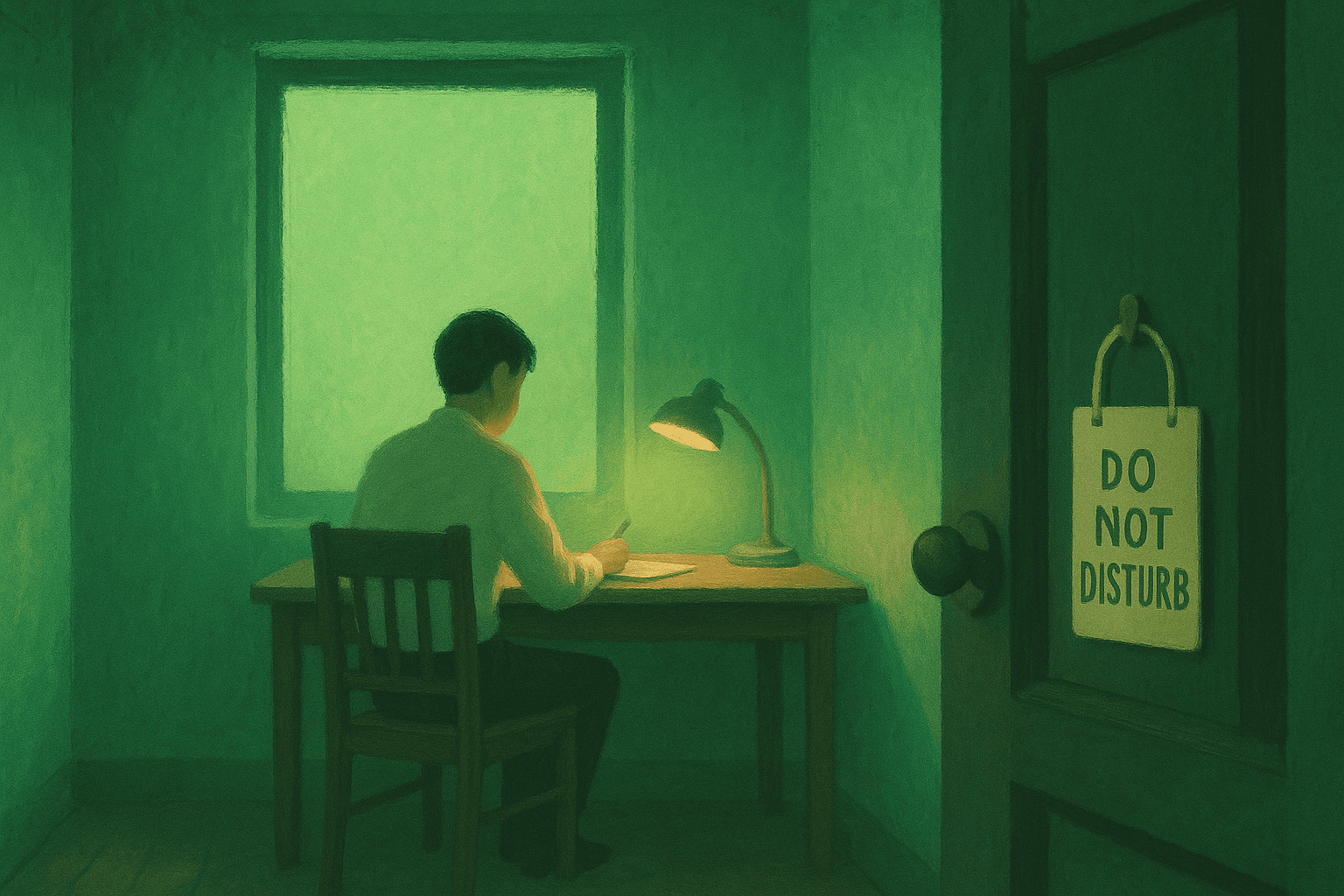
Sleep and productivity are connected more tightly than most people admit. The National Sleep Foundation's 2025 Sleep in America Poll found that 58% of adults say insufficient sleep directly hurts their productivity. But here is what the statistics miss: the link between sleep and your output is not abstract. It is specific, measurable, and personal. If you log your focus sessions with a tool like Make10000Hours for three weeks straight, a pattern emerges that no generic stat can match. Your lowest-output days, the ones where deep work felt impossible and every task dragged, almost always follow nights where you slept under six hours. That correlation, sitting in your own data, turns "sleep matters" from a cliche into a behavioral fact you can act on.
This is not another article telling you to get eight hours. This is a breakdown of what actually happens inside your brain during sleep, why that process is non-negotiable for knowledge work, and what you can do tonight to protect tomorrow's focus.
What Happens to Your Brain When You Sleep (And Why It Matters for Work)
Most sleep and productivity articles stop at "sleep is important for your brain." That is like saying "food is important for your body" and leaving it there. The mechanisms matter because they explain why specific types of work suffer most when sleep is cut short.
Your brain cycles through two primary sleep phases every 90 minutes: NREM (non-rapid eye movement) and REM (rapid eye movement). Each phase serves a distinct cognitive function that knowledge workers depend on daily.
NREM sleep handles memory consolidation. During deep NREM stages, your brain replays and reinforces neural connections formed during the day. That complex codebase you studied, the strategy document you drafted, the client conversation you navigated: NREM sleep strengthens those neural pathways so the information is accessible tomorrow. Research published in Frontiers in Systems Neuroscience confirmed that this replay process during NREM directly enhances memory retention and learning outcomes.
REM sleep recalibrates your emotional and cognitive processing. A 2024 study in Science Advances found that REM sleep recalibrates neural activity in ways that directly predict overnight memory consolidation success. During REM, your brain also restores the prefrontal cortex, the region responsible for executive function, decision making, impulse control, and sustained attention. For anyone whose job involves complex problem solving, creative thinking, or managing competing priorities, prefrontal cortex restoration is not optional. It is the biological prerequisite for showing up cognitively capable.
Here is the practical implication: when you cut sleep to six hours or fewer, you lose significant portions of both NREM and REM cycles. The first half of the night is NREM-dominant. The second half is REM-dominant. If you fall asleep at midnight and wake at 5:30 AM, you get most of your NREM but sacrifice a large share of your REM sleep. That means your memory consolidation is partially intact, but your prefrontal cortex restoration is compromised. The result: you can recall what you worked on yesterday, but you struggle to focus on it today.
If you have ADHD, this effect compounds. The prefrontal cortex is already working harder to regulate attention and impulse control in ADHD brains, which makes adequate REM sleep even more critical. For a deeper look at this intersection, see our guide on ADHD and sleep productivity.
The Real Cost of Sleeping Under 6 Hours
The costs of poor sleep stack up at every level, from your individual workday to the national economy.
Your cognitive performance drops to impaired levels. Research published in Occupational and Environmental Medicine found that staying awake for 17 hours produces cognitive impairment equivalent to a blood alcohol concentration of 0.05%. At 24 hours without sleep, that number climbs to 0.10%, which exceeds the legal driving limit in the United States. You would never show up to work after four drinks, but plenty of knowledge workers operate at that impairment level after a bad night and a strong coffee.
Your output drops measurably. The SHADES study, presented at the SLEEP 2018 conference by researcher Michael Grandner from the University of Arizona, found that workers sleeping under six hours produce 29% less output than those sleeping seven to eight hours. That is not a rounding error. Over the course of a year, that gap adds up to roughly $2,280 in lost value per employee.
Insomnia amplifies the damage dramatically. The same SHADES research showed that workers with moderate to severe insomnia experienced 107% greater productivity loss compared to those without insomnia. Even mild insomnia resulted in 58% greater loss. These are not edge cases. More than 30% of American adults report insomnia symptoms.
The macro numbers are staggering. A RAND Corporation study estimated that sleep deprivation costs the US economy over $400 billion annually in lost productivity. Fatigue-related losses cost employers approximately $1,967 per employee per year. These are aggregate figures, but they trace back to millions of individual mornings where someone opened their laptop, stared at the screen, and could not focus.
The pattern is consistent: each step down in sleep duration correlates with a measurable step down in cognitive output. There is no hack, supplement, or productivity system that compensates for a brain that did not get enough restoration time. Managing your energy starts the night before, not the morning of.
Sleep Quality Matters More Than Sleep Quantity
One of the most counterintuitive findings in sleep research is that quality often matters more than raw hours. You can spend eight hours in bed and still wake up cognitively depleted if those hours were fragmented, shallow, or inconsistent.
A field experiment conducted by the National Bureau of Economic Research in India found that participants who achieved higher-quality sleep (even with only 13 additional minutes per night on average) boosted their productivity by 2.3%. That may sound small until you compound it across weeks and months. The same study found that a nap group earned 4.1% more than a control group that took a non-sleep break of equal length.
A July 2025 study published in Nature added another dimension: irregular bedtimes were linked to lower productivity and more disengagement at work, independent of total sleep duration. Going to bed at 10 PM one night, midnight the next, and 11 PM the night after disrupts your circadian rhythm enough to impair next-day cognitive performance, even if the total hours average out.
The NSF's 2025 data supports this: 88% of people who rate their sleep as "good quality" say they are flourishing in life, compared to just 47% of those who rate their sleep poorly. Poor sleepers are 2.5 times more likely to struggle with productivity and three times more likely to fall short of their goals.
What this means for you: obsessing over hitting exactly eight hours matters less than protecting sleep consistency and minimizing disruptions. A solid seven hours of unbroken sleep outperforms a fragmented eight and a half hours every time.
If you are recovering from a period of chronic sleep deficit or burnout, rebuilding sleep quality is the foundation everything else depends on. Our guide on burnout recovery and productivity covers how to rebuild sustainable performance after a prolonged period of depletion.
6 Ways to Protect Your Sleep for Better Focus Tomorrow
These are not generic sleep hygiene tips. Each one is tied to the neuroscience above and designed to protect the specific sleep phases your cognitive performance depends on.
1. Lock your bedtime to a 30-minute window. The Nature 2025 study showed that bedtime consistency matters more than total hours. Pick a target bedtime and stay within 30 minutes of it every night, including weekends. Your circadian rhythm adjusts to predictable patterns, which means you fall asleep faster and spend more time in the deep NREM and REM stages that restore cognitive function.
2. Cut screens 60 minutes before bed, not 30. The common advice is 30 minutes. Research on blue light suppression of melatonin suggests 60 minutes produces a meaningfully larger effect. Use the last hour for reading, conversation, or low-stimulation activity. The goal is not just reducing blue light. It is letting your brain transition out of the alert, problem-solving mode that screens sustain.
3. Avoid alcohol within 3 hours of sleep. Alcohol is a sedative, which creates the illusion that it helps you sleep. In reality, alcohol fragments REM sleep, the exact phase your prefrontal cortex depends on for restoration. One or two drinks in the evening can reduce REM sleep by 20 to 40 percent. If you track your focus hours the morning after even moderate drinking, the pattern becomes obvious.
4. Anchor your wake time, not just your bedtime. Your circadian rhythm is anchored more strongly by your wake time than your bedtime. Set a consistent alarm and get bright light exposure within 30 minutes of waking. This sets the clock that determines when melatonin releases 14 to 16 hours later. If you are chasing a flow state during your morning work block, the quality of that flow session was partially determined by the consistency of your wake time over the past week.
5. Use your worst focus days as diagnostic data. Instead of treating bad work days as random, start logging them. When you track your deep work sessions daily with Make10000Hours, you can cross-reference your lowest-output days against your sleep the night before. Within two to three weeks, the correlation is usually clear enough to change your behavior. This is not a sleep tracker. It is a focus tracker that reveals what sleep (or the lack of it) actually does to your work.
6. Protect the last 90 minutes of sleep. The final sleep cycle of the night is REM-heavy. Setting your alarm 90 minutes earlier than your natural wake time cuts into the phase that restores your prefrontal cortex. If you must wake up early, shift your bedtime earlier by the same amount rather than simply sleeping less. Your mental energy during the afternoon is largely determined by whether you completed that final REM cycle.

How to See the Sleep-Productivity Pattern in Your Own Data
Population-level statistics are useful for understanding why sleep matters. But the most persuasive evidence is the pattern in your own behavior.
Here is a simple three-week experiment. You do not need a sleep tracker, a lab, or any special equipment. You need two things: a way to log your focus hours daily (Make10000Hours does this automatically by detecting when you are in sustained, distraction-free work) and a basic sleep log noting when you went to bed and when you woke up.
Week 1: Just log. Do not change anything about your sleep habits. Record your bedtime, wake time, and let Make10000Hours track your focus sessions as usual. The goal is establishing your baseline.
Week 2: Continue logging. Start noting which days felt like low-output days versus high-output days. At the end of the week, compare your focus hour totals against your sleep data from the previous nights.
Week 3: Look for the pattern. In most cases, your three to four lowest focus days will cluster after nights where you slept under six hours or went to bed more than an hour outside your normal window. The correlation is rarely perfect, but it is usually strong enough to be obvious.
What makes this approach different from reading sleep statistics is that it is yours. You are not relying on a study of 1,007 adults. You are looking at what sleep deprivation does to your specific focus capacity, in your specific work context, on your specific projects. That personal evidence changes behavior in a way that no article, including this one, can replicate on its own.
The CEPR found that each additional hour of sleep per week increases weekly earnings by 3.4%. That is the population average. Your individual number might be higher or lower. But you will never know until you measure it.
Frequently Asked Questions
How does lack of sleep affect productivity?
Lack of sleep impairs the prefrontal cortex, which controls attention, decision making, and impulse regulation. Research shows that workers sleeping under six hours produce 29% less output than those sleeping seven to eight hours. The cognitive impairment from 17 hours of wakefulness is equivalent to a 0.05% blood alcohol concentration. For knowledge workers, this translates to slower problem solving, more errors, difficulty sustaining focus, and poorer decision quality throughout the day.
How many hours of sleep do you need to be productive?
Most research points to seven to eight hours as the range that supports optimal cognitive performance. The NSF's 2025 data shows that adults sleeping within the recommended range are significantly more likely to report flourishing in both work and life. However, quality and consistency matter at least as much as total hours. Seven hours of unbroken, consistent sleep often outperforms eight and a half hours of fragmented or irregular sleep.
Does sleep quality matter more than sleep quantity for work performance?
Yes, multiple studies support this. An NBER field experiment found that even 13 additional minutes of higher-quality sleep per night boosted productivity by 2.3%. A 2025 Nature study showed that irregular bedtimes reduce next-day productivity regardless of total sleep hours. Protecting sleep quality means minimizing disruptions, maintaining a consistent schedule, and avoiding substances like alcohol that fragment REM sleep.
Can you track the connection between sleep and focus?
You can, and the results are often surprising. By logging your focus sessions daily with a tool like Make10000Hours and recording your sleep times for three weeks, you can see the correlation in your own data. Most people discover that their lowest-output days consistently follow nights of poor or insufficient sleep. This personal data is more motivating than any population-level study because it shows what sleep does to your specific work.
What is the economic cost of sleep deprivation in the workplace?
Sleep deprivation costs the US economy over $400 billion annually according to RAND Corporation research. At the individual employer level, fatigue-related losses average approximately $1,967 per employee per year. Workers with moderate to severe insomnia experience 107% greater productivity loss compared to well-rested peers. These costs come from slower output, increased errors, higher absenteeism, and more workplace accidents.
How does REM sleep affect focus and memory?
REM sleep is when your brain restores the prefrontal cortex and recalibrates neural activity for memory consolidation. A 2024 study in Science Advances found that the extent of REM sleep recalibration directly predicts overnight memory consolidation success. When you cut sleep short, you lose REM-heavy cycles from the second half of the night, which compromises executive function, creative problem solving, and sustained attention the following day.
What are signs that poor sleep is hurting your work?
Common signs include difficulty starting tasks in the morning, needing multiple attempts to focus on a single problem, increased irritability with coworkers, relying heavily on caffeine to reach baseline alertness, and noticing that your afternoon productivity drops significantly. The NSF found that poor sleepers are 2.5 times more likely to struggle with productivity and three times more likely to fall short of their goals compared to good sleepers.
Sleep is not a luxury you trade for more work hours. It is the biological infrastructure that makes productive work possible. Every hour of genuine focus you log tomorrow depends, in part, on what happens tonight. If you have never tracked the connection between your sleep and your actual output, Make10000Hours makes the pattern visible. Start logging your focus sessions today, and within three weeks you will have personal proof of what the research already shows: protecting your sleep is the highest-leverage productivity decision you can make.
Related articles