Yes, creatine does help focus, and the evidence is more solid than most nootropics can claim. Multiple peer-reviewed studies show creatine improves short-term memory, information processing speed, and cognitive performance, particularly under sleep deprivation and mental fatigue. The effect is not uniform across all people, which is exactly why tracking your own response matters. Make10000Hours lets you measure actual focus session quality before and after starting creatine, so you get personal data instead of relying on study averages.
Table of Contents
- Does Creatine Help Focus? The Short Answer
- How Creatine Powers the Brain
- What the Research Actually Shows
- Creatine and Sleep Deprivation: The Strongest Signal
- Who Benefits Most From Creatine for Focus?
- How to Use Creatine for Cognitive Benefits: Dose and Protocol
- How to Know If Creatine Is Actually Helping Your Focus
- Frequently Asked Questions
Does Creatine Help Focus? The Short Answer
Yes, with important nuance.
The clearest evidence is in two areas: short-term memory and reasoning in people who are metabolically stressed (sleep-deprived, cognitively fatigued, or running on low dietary creatine), and memory and processing speed in older adults. A 2024 meta-analysis of 16 randomized controlled trials covering 492 participants found creatine monohydrate significantly improved memory (standardized mean difference of 0.31), attention time, and information processing speed compared to placebo.
Where the evidence is weaker: well-rested, healthy young adults eating meat regularly tend to show smaller or no cognitive benefits. That makes sense. If your brain creatine stores are already close to full, supplementation has less room to work.
The bigger picture: creatine is not a magic focus pill. It is a cellular energy buffer. When your brain is under strain, having more of that buffer available makes a measurable difference. The more cognitively demanding your work, the more relevant creatine becomes.
For knowledge workers who regularly push through long sessions, deep work blocks, or irregular sleep, that distinction matters a lot. This is why nootropics for focus consistently puts creatine near the top of the evidence-backed list.
How Creatine Powers the Brain
Creatine is not a stimulant. It does not boost neurotransmitters directly the way caffeine blocks adenosine or modafinil suppresses sleep drive. It works lower down the energy stack.
The brain accounts for roughly 2% of your body weight but consumes over 20% of your available energy. Every focused thought, every decision, every moment of sustained attention draws down your brain's ATP (adenosine triphosphate) supply. When you think hard for extended periods, that supply gets depleted faster than it can be replenished.
This is where creatine comes in. The phosphocreatine system is your brain's rapid energy recharge mechanism. Creatine combines with a phosphate group to form phosphocreatine, which sits ready to donate that phosphate back to ADP to regenerate ATP instantly, without waiting for slower metabolic pathways. It is essentially a buffer between energy supply and energy demand.
When you supplement creatine, you increase the amount of phosphocreatine available in brain tissue. The result is a larger buffer. Under normal rested conditions, this extra buffer may not show up meaningfully in cognitive tests. But under mental fatigue, sleep deprivation, or sustained high-demand cognitive work, having that larger buffer available is where the measurable difference appears.
This is the same reason creatine has been used in sports performance for decades: it is the energy-on-demand molecule. The brain runs on the same basic system as muscle, just in a different tissue.
For a broader look at brain energy optimization strategies, see brain optimization for work.
What the Research Actually Shows
The evidence on creatine and cognitive function has been building for over two decades. Here is the arc:
Rae et al. 2003 (Oxford University) is the landmark study. In a double-blind, placebo-controlled crossover trial, 45 young adult vegetarians took 5g of creatine monohydrate per day for six weeks. Compared to placebo, the creatine group showed significant improvements on the Wechsler digit span backward task (working memory) and Raven's Advanced Progressive Matrices (intelligence and reasoning). This was a clean result in a carefully controlled study. It was also specifically in vegetarians, which matters for reasons covered in the next section.
Rawson and Venezia (2011) reviewed the accumulating evidence and concluded that creatine's cognitive effects are most consistent under conditions of metabolic stress: sleep deprivation, exercise fatigue, or oxygen deprivation. Their review helped frame the central insight that has held up in subsequent research: creatine is not a universal cognitive enhancer. It is a stress-state cognitive buffer.
Avgerinos et al. 2018 published the first major systematic review, covering 6 randomized controlled trials with 281 participants. Their conclusion: oral creatine administration may improve short-term memory and intelligence/reasoning in healthy individuals. They found that vegetarians responded better than meat-eaters in memory tasks, and that elderly individuals benefited more than young adults. Other cognitive domains (long-term memory, spatial memory, attention, executive function) showed conflicting results.
Prokopidis et al. 2022 (Oxford Academic, Nutrition Reviews) published a meta-analysis specifically on memory and found creatine significantly improved memory performance versus placebo, with especially strong effects in older adults aged 66 to 77.
Frontiers in Nutrition meta-analysis (2024) is the most current comprehensive analysis: 16 RCTs, 492 participants, published studies from 1993 to 2024. Results: creatine monohydrate significantly improved memory (SMD 0.31), attention time, and processing speed. No significant improvement in overall cognitive function scores or executive function. Effects were stronger in individuals with existing health conditions, in participants aged 18 to 60, and in female participants.
The honest picture: memory and processing speed have the most consistent evidence. Executive function, reaction time, and general cognitive composite scores are inconsistent across studies. The magnitude of the effect is moderate, not dramatic. But moderate effects that are reliably reproducible across multiple high-quality studies are more trustworthy than dramatic effects from a single study.
For context on how creatine compares to other evidence-backed cognitive supplements, see best nootropics productivity and cognitive performance hacks.
Creatine and Sleep Deprivation: The Strongest Signal
This is the most practical finding for knowledge workers.
A 2024 study published in Scientific Reports (Nature) tested a single high dose of creatine (approximately 0.35g per kilogram of body weight) after 24 hours of sleep deprivation. The results were striking: creatine partially reversed the cognitive deterioration caused by sleep deprivation, as measured by both cognitive performance tests and direct measurement of cerebral phosphocreatine levels via brain imaging. The peak cognitive effect appeared at approximately 4 hours after ingestion and lasted up to 9 hours.
This challenges the assumption that creatine only works after weeks of loading. A single targeted dose can produce measurable cognitive effects in the right context.
Earlier work by McMorris et al. (2006) found that creatine supplementation had a positive effect on mood and tasks placing stress on the prefrontal cortex following 24-hour sleep deprivation. This is directly relevant: the prefrontal cortex is the region most responsible for sustained attention, decision quality, and executive focus.
The mechanism makes sense. Sleep deprivation depletes brain phosphocreatine stores. Supplementing creatine replenishes those stores, giving the brain more energy to work with despite the sleep deficit.
The practical implication for knowledge workers: creatine is not just a supplement for gym days. If you are running a sleep deficit during a high-stakes work period, a pre-loaded creatine protocol may help maintain the cognitive quality of your focus sessions more than most "pick me ups" will. Unlike caffeine, which suppresses the sensation of fatigue without addressing the underlying energy deficit, creatine targets the deficit directly.
Who Benefits Most From Creatine for Focus?
Not everyone responds equally. The research points to several groups that consistently show the strongest cognitive effects:
Vegetarians and vegans. This is the most consistent finding across the research. Dietary creatine comes almost entirely from meat and fish. Vegetarians and vegans have significantly lower baseline brain creatine levels. Rae et al. 2003 was conducted entirely in vegetarians for this reason. Avgerinos et al. 2018 confirmed vegetarians respond better than meat-eaters in memory tasks. If you do not eat meat, your baseline is lower, which means supplementation has more headroom to improve your cognitive performance.
Older adults. The 2022 Oxford Academic meta-analysis found especially strong memory improvements in adults aged 66 to 77. The brain's creatine synthesis and storage capacity tends to decline with age, making supplementation more impactful. This is a consistent finding across reviews.
People under metabolic stress. Sleep-deprived, cognitively fatigued, or operating under sustained high cognitive load: these are the conditions where creatine's buffering function matters most. Rawson and Venezia's 2011 review makes this case clearly. If you work demanding cognitively intensive hours, you are more likely to benefit than someone doing low-effort routine tasks.
Women. Research shows women may store up to 80% less creatine than men due to lower muscle mass and hormonal factors. The 2024 Frontiers meta-analysis found effects were stronger in female participants. Women in perimenopause and menopause face additional hormonal influences on creatine storage (estrogen affects creatine availability), making supplementation particularly relevant for this group.
Meat-eaters in ordinary circumstances. If you are a healthy young male who eats meat regularly, sleeps well, and is not under sustained cognitive stress, your baseline brain creatine is likely already fairly high. You may see little to no effect. This is not a failure of the supplement. It is the buffer already being full.
For comparison with other cognitive stacks, see caffeine l-theanine stack, which has a different mechanism and benefit profile that can complement creatine rather than replace it.
How to Use Creatine for Cognitive Benefits: Dose and Protocol
This is where the muscle-focused advice diverges from the brain-focused evidence.
Standard muscle-building protocol: 3 to 5g per day, taken consistently. This is what most people follow.
Brain creatine loading protocol: The PMC "Heads Up" review (2023) identifies two protocols that reliably increase brain creatine levels:
- 20g per day for 4 weeks, then maintenance at 3 to 5g per day
- 5g per day for 8 weeks to achieve a similar increase in brain creatine more gradually
The reason this differs from muscle protocol is the blood-brain barrier. Creatine reaches muscle tissue easily, but brain uptake is limited by transporter availability at the blood-brain barrier. Higher or longer-duration dosing is needed to meaningfully raise brain creatine levels compared to what's needed for muscle creatine.
Form: Creatine monohydrate is the most researched form and the one used in virtually all the studies above. There is no strong evidence that other forms (creatine HCl, creatine ethyl ester, buffered creatine) are more effective. Stick with monohydrate.
Timing: Timing does not appear to matter significantly for chronic supplementation. For the acute sleep deprivation use case, the 2024 study used a single dose timed to the period of sleep deprivation, with effects peaking around 4 hours after ingestion.
Hydration: Creatine draws water into cells. Increase your water intake when supplementing, especially during the loading phase.
Creatine with caffeine: The relationship is complex. Some older studies suggested caffeine might blunt creatine uptake into muscle, but this finding has not been consistently replicated. For cognitive purposes, there is no strong evidence that combining creatine with caffeine is counterproductive. Many people stack both. However, if you are using the acute sleep-deprivation protocol, consider keeping variables simple.
Safety: Creatine is classified as Generally Recognized as Safe (GRAS) by the FDA. Over 1,000 peer-reviewed papers have been published on creatine supplementation. The most commonly reported side effects are minor: bloating and water retention, primarily during the loading phase. People with pre-existing kidney conditions should consult a physician before supplementing.
How to Know If Creatine Is Actually Helping Your Focus
This is the question almost no one asks, and no competitor answers it.
Study results are population averages. A meta-analysis showing a statistically significant improvement in memory does not tell you whether you, specifically, with your diet, sleep patterns, cognitive baseline, and work demands, will see a measurable benefit.
The skeptic's approach: run a personal n=1 experiment with real data.
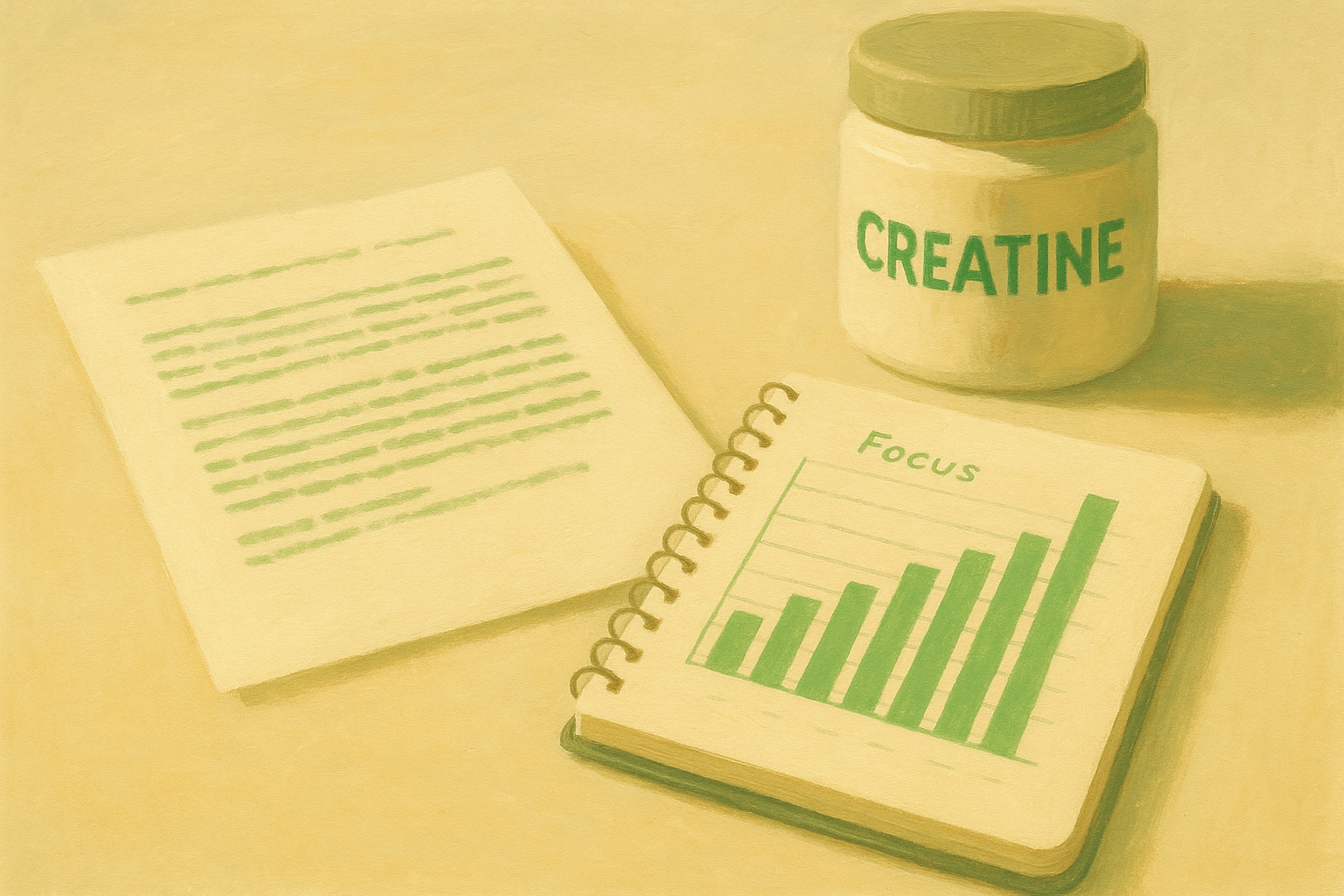
Make10000Hours tracks your actual computer activity and detects focus session quality over time. The approach is straightforward:
Week 1 to 2: Baseline. Do not take creatine. Track your focus sessions normally. Make10000Hours records your session depth, duration, and quality automatically. This is your pre-supplementation benchmark.
Week 3 to 6: On creatine. Start your protocol (5g per day). Keep your sleep, exercise, and caffeine intake as consistent as possible. Let the AI track your focus sessions.
Week 7: Compare. Look at the data. Did your average session depth change? Did you sustain deep focus longer before dropping out? Did your cognitive output (measured by your actual work, not self-report) shift?
This is more useful than trusting a study average, because it is your data, your conditions, and your brain. The research tells you there is reasonable prior probability that creatine will help, especially if you are vegetarian, chronically sleep-deprived, or doing cognitively demanding work. Your tracked data tells you whether it actually helped you.
Being the skeptic who tests is more valuable than being the believer who assumes.
Frequently Asked Questions
Does creatine help with focus and concentration?
Yes, with the clearest evidence in situations involving sleep deprivation or sustained cognitive load. Multiple systematic reviews show creatine improves short-term memory and processing speed. The effect on general focus and concentration in well-rested, healthy young adults is less consistent, but the sleep-deprivation evidence is robust.
How does creatine improve cognitive function?
Creatine increases the brain's phosphocreatine stores, which serve as a rapid energy reserve. During cognitively demanding tasks, ATP gets depleted faster than standard metabolic pathways can replenish it. Phosphocreatine donates its phosphate group to regenerate ATP instantly, extending the brain's ability to sustain high-energy cognitive activity. It is an energy buffer, not a stimulant.
Who benefits most from creatine for the brain?
Vegetarians and vegans benefit most because dietary creatine comes almost entirely from meat, leaving plant-based eaters with lower baseline brain creatine levels. Older adults (particularly 60+) also show consistent benefits. People under metabolic stress (sleep-deprived, cognitively fatigued) benefit more than well-rested individuals. Women may benefit more than men due to lower baseline creatine stores.
How long does creatine take to improve focus?
For chronic supplementation, meaningful increases in brain creatine levels take approximately 4 to 8 weeks depending on dose (20g per day for 4 weeks, or 5g per day for 8 weeks). For the acute sleep deprivation use case, a single high dose can produce measurable cognitive effects within hours, peaking around 4 hours after ingestion according to a 2024 Nature study.
What is the best dose of creatine for cognitive benefits?
For brain-specific effects, a loading protocol of 20g per day for 4 weeks is more effective at increasing brain creatine levels than the standard 3 to 5g muscle maintenance dose. Alternatively, 5g per day for 8 weeks achieves similar brain creatine saturation more gradually. After loading, 3 to 5g per day as maintenance is standard. Always use creatine monohydrate for the most evidence-backed results.
Does creatine work as a nootropic?
Yes, with caveats. By the standard definition of nootropics (substances that improve cognitive function), creatine qualifies based on its evidence for memory and processing speed. It is one of the few supplements where the cognitive evidence comes from multiple well-designed RCTs and meta-analyses rather than single studies or animal models. The effect size is moderate rather than dramatic, which is actually a sign of reliability.
Is creatine safe to take long-term for brain health?
The safety profile is strong. The FDA classifies creatine as GRAS (Generally Recognized as Safe). Over 1,000 peer-reviewed studies have been published on creatine supplementation with no consistent evidence of harm in healthy adults. Minor side effects like bloating and water retention are common during loading phases but typically resolve. People with pre-existing kidney disease should consult a physician before supplementing.
Can creatine help with brain fog?
Potentially, especially if your brain fog is related to sleep deprivation, dietary deficiency (vegetarians and vegans), or sustained cognitive overload. Creatine improves brain energy availability, which addresses one common contributor to brain fog. If your brain fog has other causes (thyroid, iron deficiency, poor sleep architecture), creatine alone is unlikely to resolve it. Use tracking data from a tool like Make10000Hours to assess whether creatine actually shifts your cognitive clarity.
Does creatine help with sleep deprivation recovery?
Yes, this is among the strongest evidence for creatine's cognitive effects. A 2024 study in Scientific Reports found that a single high dose partially reversed cognitive decline from 24-hour sleep deprivation, with peak effects at 4 hours post-ingestion lasting up to 9 hours. Earlier research by McMorris et al. confirmed positive effects on prefrontal cortex function and mood under sleep deprivation. Creatine addresses the phosphocreatine depletion that occurs in the brain during sleep loss.
Every study cited above is a population average. Your response depends on your baseline creatine stores, your diet, your sleep patterns, and the cognitive demands of your actual work. The research gives you strong prior evidence that creatine is worth testing. Your personal focus data tells you whether it worked for you specifically.
Track your baseline for two weeks before starting creatine. Log your focus sessions with Make10000Hours. Then run four weeks on the protocol and compare. That four-week window is more useful than any meta-analysis for making a decision about your own brain.
Related articles